Saturday, July 3, 2021

What Do Blind People See?


Vision runs the gamut from super vision to total absence of sight.  To be classified as ‘legally blind’, a person’s visual acuity must be 20/200 or less in their best eye with the aid of conventional eyewear or their field of vision must be less than 20 degrees in their best eye with the aid of conventional eyewear.  More information about this is available at the American Foundation for the Blind at https://www.afb.org/blindness-and-low-vision/eye-conditions/low-vision-and-legal-blindness-terms-and-descriptions?gclid=CjwKCAjwz_WGBhA1EiwAUAxIcc_zUTzmjI5_IbkCjL8SWUiGJXmbB1d4R1z93SYuWl-MgXMso3FRYhoCAGQQAvD_BwE#LowVision_vs._LegalBlindness.

We know that normal visual acuity is 20/20, but what does that mean?  It refers to the fact that a person with normal vision can see things as clearly at 20 feet as other normally sighted individuals can see from the same distance. Many outstanding athletes have superior vision that may be as good as 20/10.  In other words, they can see things at 20 feet that others cannot see unless they are 10 feet away.

If someone’s vision is 20/200, they will need to be 20 feet away from something in order to be able to see it as well as a normally sighted person can see from 200 feet.  This is the minimal condition for legal blindness, but this limited definition does not take into account the numerous visual obstructions and distortions that are produced by various eye disorders. Approximately 15 percent of those effected are totally blind.  The remaining 85 percent see something even if it is nothing more than the ability to perceive light.

I have been dealing with macular degeneration since childhood.  Initially, I could simply not read what my teachers wrote on the blackboard.  Eventually I needed large-print books or magnifying glasses to read text.  Over the years my condition has gradually grown worse.  In the beginning, I was aware of a small blind spot in the center of my sight that prevented me from seeing details.    Progressively, that region has increased and obstructed greater portions of my field of vision.

At present, my world is a distortion of light and dark smudges in various shapes and sizes periodically overshadowed by bright defused clouds of light stemming from lamps, sunlight and other sources of illumination.  In familiar surroundings, I can generally interpret these images and navigate adequately.  In unfamiliar environments, it is just a senseless array of confusion.

While my physical sight is extremely limited, I see my mental challenges quite clearly.  Simply moving around my own home requires a great deal of concentration.  Imagine trying to drive along a winding mountain road in the dead of night with a heavy fog all around. Consider the relief you would experience upon reaching your destination. Similarly, when I crawl into bed at night, I am grateful to be able to close my eyes and simply rest.

When I misjudge a doorway, step or table, I often rediscover the laws of gravity and physics, It really is true that two objects cannot occupy the same space at the same time. Those events often generate feelings of anger, frustration and, quite frankly, humiliation.  No, I shouldn’t feel humiliated, but when my forehead or nose strikes the edge of an open door, I do, nonetheless.

I find that I have a strong need to feel useful.  Thankfully, I have been able to manage a moderately successful massage practice for the past eighteen years.  The hardest part is maintaining my schedule. The actual massage procedure comes easily to me because I depend so heavily on my sense of touch. 

I do what I can to help out around the house.  My loving wife offers guidance, expresses gratitude for my efforts and silently endures my blunders.  Thankfully, a significant amount of housework does not require much visual detail.  I can easily empty the trash, fold laundry, load and unload the dishwasher and feed our pets. I even manage to do a little cooking.

Like most people with disabilities, those with visual limitations see a wide range of social challenges.  I know a woman who is totally blind.  She sums up her experience at social events as “park her, feed her and leave her.”  I don’t get the impression that it really is a complaint on her part, merely an observation of reoccurring events.  I told her it sounds like a legal firm, but I know exactly what she means. 

Personally, I feel very comfortable with this approach.  Upon entering a social gathering, the first thing I want to do is find a place to sit down.  It takes me out of the flow around me and offers a sense of stability.  I like to eat, so I’m always thankful for a plate of food as long as it is easy finger food and doesn’t include dip, toppings, or anything else that is messy.

Furthermore, I don’t expect anyone to feel obligated to entertain me.  We are there for social interaction.  It would be selfish for me to expect my wife or anyone else to babysit me.  I am generally quite content to listen to the conversations I overhear. Depending on the size and setting of the event, I occasionally am able to join in.

Engaging in dialog in a restaurant or large gathering is challenging.  Sighted people have numerous visual cues to aid in the interaction.  Facial expressions, body language, hand gestures and the ability to watch the movement of lips as people talk all supplement what is being said even when the voices may not be fully heard.  Without those cues, much of the interaction is easily missed.

In small groups, I try to engage in conversations.  I am aware that I occasionally commit social gaffes, but my friends are quite understanding about that.  In larger settings, I prefer to remain quiet and avoid misdirecting the dialog.

Communication is often awkward for those who are blind, but it is also challenging for those with limited experience interacting with people who have disabilities.  Is it appropriate to say, “It’s good to see you?”  Of course, it is, and I will probably say the same.  For a sighted person, the expression may be literal.  For me, it is figurative.

In restaurants, food servers are notorious for taking orders from everyone in the dining party and then gesturing toward one who is disabled and asking the rest of the group, “What does he/she want?”  In those situations, my wife often says, “Honey, she is ready for your order.”  In one restaurant we frequented, she told the server my name so that she could direct her questions to me personally.

I see myself as an educator.  For those who don’t know how to engage with people who are blind, I try to kindly inform them so they will be able to do better in the future.  Frequently in medical offices, I ask aides to allow me to take them by the elbow so they can lead me to a treatment room.    In subsequent visits, I often find that they take the initiative to offer their elbow without me having to ask.


I think that most people want to be helpful but aren’t sure what to do or how to act.  My task is to supply that information in a way that will encourage their natural tendency.  Being angry or belligerent will only make them want to run in the opposite direction the next time they encounter someone with a disability.

Perhaps the most important thing that blind people are ideally suited to see is a lesson that has been taught by most spiritual leaders over several millennia:  who individuals are is far more important than how they appear.   Certainly, we are capable of being superficial in other ways, but jewelry, apparel, facial features and body shape are less likely to influence our initial perceptions about those we encounter or distract us from personal development.  Thankfully, physical limitations do not restrict one’s effort to nurture a meaningful inner life.  Conversely, fashion and beauty are multi billion dollar industries that too often mask severely damaged souls.  This is one area where blindness might actually be a blessing.

What do blind people see?  Physically, that varies widely based on the nature and severity of the visual disorder.  In life, we see how demanding things can be in order to attain even a moderate level of success.  Within ourselves, we see whether we possess the courage and determination to prevail. Mentally, creatively, socially, emotionally, intellectually and spiritually our perceptions are 20/20 and, for some, perhaps 20/10.

Monday, August 10, 2020

Don't Help To Re-elect Our Current President


I am a seventy-year-old white guy who reached adulthood in the late 60’s and early 70’s when there was a general feeling among the youth of our nation that, like today,  we were on the brink of a new age of social awakening.  In 1979, as a Pentecostal pastor, I founded a church in southern Maryland that had a congregation that was predominately black and ministered there until 2001.  Now, I am a Quaker and recently designed a wristband with black and white hands shaking, the words, “Black Lives Matter to Me: and a red heart with a peace sign in the middle to proclaim a commitment to racial justice and harmony in a spirit of peace and love. I am only presenting this to say that as much as I am able, I understand and welcome the peaceful aspects of the BLM movement.

I am, however, deeply concerned that those who are caught up in aggressive/violent protests do not recognize that they are playing right into the hands of our current president.  Fearmongering is his primary tactic. It is what propelled him into the White House and is already evident in his political advertising this year. Engaging in acts of destruction is spreading fear among many citizens who might otherwise support a progressive agenda and allowing him to present himself as the only means of restoring law and order.

Consider the accomplishments of those who ‘fought’ for racial equality in the latter half of the 20th century.  Their foundational commitment was to non- violent civil disobedience.  Their possession of the moral high ground was radiantly clear as they suffered injustice while maintaining a spirit of patience and love.  Their efforts led to passage of landmark civil rights legislation and prepared a path straight to the White House for our first African American president.

Your outrage over systemic racism and police brutality is completely justified.  However, we live in a democracy ruled by laws enacted by elected representatives.  Protests may provide a voice for the disenfranchised, but the election of politicians who share those concerns is the way to bring about meaningful and lasting change.

De you feel a need to do something.  If you must protest, take the wind out of Trump’s sails and do it peacefully.  If you want to be even more effective, channel that energy into voter registration efforts and create a voting block that is focused and powerful.  Coordinate transportation resources for election day that will ensure that everyone has a way to get to and from their voting location. If you live in a state that supports it, help your family members, friends and neighbors utilize early voting or mail-in ballots.

It has been said that in a democracy people get the government that they deserve.  In 2016, voter indifference allowed racism to usher Donald J. Trump into the highest elected office in our nation. I pray that we do not repeat this mistake.  Let us make every effort to ensure that this year we elect individuals who will faithfully work towards a time when there is truly freedom and justice for all.

We must embrace the final message from our recently departed national treasure, Rep. John R. Lewis.

“Ordinary people with extraordinary vision can redeem the soul of America by getting in what I call good trouble, necessary trouble. Voting and participating in the democratic process are key. The vote is the most powerful nonviolent change agent you have in a democratic society. You must use it because it is not guaranteed. You can lose it.

You must also study and learn the lessons of history because humanity has been involved in this soul-wrenching, existential struggle for a very long time. People on every continent have stood in your shoes, through decades and centuries before you. The truth does not change, and that is why the answers worked out long ago can help you find solutions to the challenges of our time. Continue to build union between movements stretching across the globe because we must put away our willingness to profit from the exploitation of others.

Though I may not be here with you, I urge you to answer the highest calling of your heart and stand up for what you truly believe. In my life I have done all I can to demonstrate that the way of peace, the way of love and nonviolence is the more excellent way. Now it is your turn to let freedom ring.

When historians pick up their pens to write the story of the 21st century, let them say that it was your generation who laid down the heavy burdens of hate at last and that peace finally triumphed over violence, aggression and war. So, I say to you, walk with the wind, brothers and sisters, and let the spirit of peace and the power of everlasting love be your guide.”

Saturday, December 9, 2017

Christmas

To celebrate or not to celebrate, that is the question.  As a nontheist, is it better to abstain from participation in all forms of religious observances?  Or, is it possible to embrace the sentiment of the Christmas season without endorsing the supernatural beliefs associated with it?
I fear that it is possible to become so enamored with and restrained by our intellect that we deny ourselves the immense joy of merely experiencing life.  I don’t want to wind up like Ebenezer Scrooge, sitting alone on Christmas eve eating a bit of stale bread and a small wedge of cheese while railing against the ghosts of Christmases past, present and future.  Surely there is some way to join in the festivities and warmth of fellowship with family and friends with the full knowledge that it is all about community, not deity.
The Christmas story embodies some of the most profound hopes and aspirations of the human heart.  It reverently affirms the sacred potential implicit in the birth of an innocent child whose destiny  is one of personal sacrifice to bring about reconciliation and world peace.  The significance of this was acknowledged by the learned and wealthy wise men and the lowly shepherds, alike.  How different our world would be if each newborn was greeted with such anticipation and nurtured to embrace that noble mission.
So, with this perspective in mind, bring on the religious services, the choirs and flickering candles.  Send the cards bearing the messages of love, joy, hope and peace.  String the lights; ring the bells; erect the trees; and hang the decorations.   Find meaningful ways to gather together and share the essence of the Christmas story.  Drink hardily from the joy expressed in the wide-eyed anticipation of the children.

Finally, I would like to say Merry Christmas, Jesus; Merry Christmas, Tiny Tim; Merry Christmas, Ebenezer; Merry Christmas to all of my theist and nontheist family and Friends/friends; and may the universe bless us, everyone. 

Friday, December 1, 2017

What About God? - Part III of III

There is a cosmic mystery that is absolutely perplexing in which we play some sort of role.  It is generally referred to as synchronicity.  For those who may not be familiar with the term, it refers to related events that occur without a causal connection.
An example might be helpful.  Let’s suppose I am thinking about a friend who I have not been in contact with for many years, and he suddenly calls.  The two events are my thoughts and his call.  They are related, but neither caused the other to happen as far as we know.  This would be considered a synchronistic occurrence.
Some might suggest that this is no more than a random coincidence.  However, what explanation do we offer when these types of events occur frequently and with high levels of improbability?  How do we dismiss a phenomenon that is so ubiquitous that it has been recognized in every culture throughout the ages?
Numerous books have been written on the subject of synchronicity.  Some consider this the intervention of God.  Others view this as some form of cosmic consciousness.  Although I recognize the validity of this aspect of reality and experience it on a regular basis, I have no idea what the source is. 
I am not troubled by our current inability to empirically validate the authenticity of this phenomenon.  Long before science identified the existence of viruses and bacteria, people recognized that there was a connection between cleanliness and disease.  We still don’t know precisely how gravity works.  Nevertheless, we acknowledge its existence and can now precisely measure its influences.
At present, the evidence of synchronicity is purely anecdotal.  I would have to write extensively in order to convey all of these types of experiences I have had personally.  Instead, I will share just one that illustrates why I acknowledge something that I cannot explain.
In August of 2002 I was licensed as a massage therapist and set up practice in a small shopping strip in February of the following year.  By May 2004, I had developed a clientele that was sufficient to pay my bills but did not generate any significant profits.  At that time, I was reading a book that promoted the idea that our thoughts can influence events.  Skeptically one afternoon I sat in my living room and briefly and silently directed my desire for more income towards the universe.
Within thirty minutes I received a phone call from the executive director of a non-profit organization called Alternative Medicine Integration (AMI).  They were part of a pilot program in Florida that administered funds for alternative medical services to Medicaid recipients who had chronic back pain.  The director informed me that he was seeking massage therapists in my area and was calling to see if I would be interested in becoming a provider.
As he explained the program, I learned that they would refer clients to me to receive treatments twice each month.  Furthermore, the compensation they were offering was twice the amount that I normally charged.  They were seeking practitioners with at least 3 years of experience; however, even though I had been licensed for less than two years, I was invited to participate anyway and eagerly accepted.
The details are so specific that the synchronistic nature of this event is undeniable.  Similar experiences both prior and since have convinced me that there is some organizational force at work in the universe that we do not currently understand.  It is not something I can summon at will, but neither am I surprised when it occurs.
Synchronicity certainly offers the impression that someone is observing and responding to our needs.  Undoubtedly it lies behind the extensive belief in the importance of prayer and innumerable forms of religious observances.  However, these providential events occur despite any particular belief or ritual.  If this is God, She is acting with complete indifference to our theology.
Any positive fulfillment of an appeal to higher power tends to affirm the validity of one’s cosmic perspective.  One person prays to the Virgin Mary.  Another makes an offering before a Buddhist statue.  A third merely issues a silent appeal to the universe at large.  As events reveal an apparent response, there is an assurance that they have followed the proper path.
Often, needs are met, and issues are resolved in extremely detailed and specific manners.  But, is this actually evidence of God? Is it possible that there is an organizational field that can be accessed which is capable of directing events in our lives without any cognitive awareness?
It is challenging to conceive of an organizational force that is not directed by some form of intelligence.  Here, ancient Vedic teachings may be of some help.  Beginning thousands of years ago, yogis taught that the human body is a microcosm of the universe.  Considering that simple observation offers significant insights.
We make many decisions with the use of our intellect.  Nonetheless, our very existence requires no thought at all.  The cells, tissues, organs and systems in our bodies function in a harmonious rhythm completely independent of our cognitive direction.  In fact, if we had to rely on remembering to breathe and maintain the rhythm of our heart, most of us would be dead within an hour.  Furthermore, we wouldn’t be able to concentrate on anything else.
What is true of the human body applies to all life forms.  From the simplest cell to the most complex ecosystem, completely natural processes function throughout our global biosphere without any cognitive direction.  Indeed, our entire planet demonstrates this self-directed inherent order and balance.
Is synchronicity simply one more expression of this natural tendency to achieve homeostasis?  Perhaps these synchronistic events are not intended to meet our individual needs.  What if we are merely being positioned to fulfill our role as an integral aspect of the greater fabric of existence.? 
Considering the role of synchronicity in our lives and the world at large is fascinating, but contemplating the implications on a cosmic scale leads to unanswerable speculation.  Is it possible that this organizational force is the underlying factor driving the progressive complexification presented in chapter 4? Is it responsible for forming matter, generating life on the earth, spawning complex organisms, and stimulating the development of human consciousness?  If so, the universe is probably filled with various life forms, some of which may exhibit intelligence equal to or exceeding our own.
If someday we encounter extraterrestrials, it will be interesting to find out what insights they may be able to provide regarding our unresolved cosmic questions.  What will they think of the violence associated with so many of our philosophical differences.  Is it possible that they will delay any contact with our species until we reach a higher level of social development? Will their culture have a religious history?  What will they be able to tell us about their understanding of God?
Does God exist?  If we can avoid rendering our planet uninhabitable, in a thousand or perhaps ten thousand years we may have a more definite answer to that question.  For now, what is certain is that we must grant to others the same right we wish for ourselves, that we are free to believe what satisfies our mind and comforts our heart.
If we fulfill the essential teachings of religion, we will love one another and live in peace.  If we embrace the synergy at work in the universe, we will acknowledge our interconnection and interdependence and seek to develop mutually supportive social relationships.  The results are potentially identical, a global community that is founded on mutuality.
Our existence may be due to the actions of a deity or merely a natural event.  If God exists, it is rather certain that He is far different than those conceptions formulated thousands of years ago.  As we grow in our knowledge about the universe, our challenge is to remain open to whatever insights may await us as we discover what it means to be at home among the stars.

Reflections:

-         If you were God, how would you make the world better for mankind?

-         If we all worked together, how could we bring about those changes without divine intervention?

Wednesday, November 8, 2017

What About Goc? - Part II of III

Around 300 BCE, Aristotle developed an elaborate model of the universe that enabled the calculation of the movement of various heavenly bodies.  It was not precisely accurate but was close enough to garner complete acceptance for 2, 000 years.  Unfortunately, his fundamental precept that the earth was the center of the universe and was orbited by the sun, moon and stars was completely wrong.  With intense opposition the Copernican model of a heliocentric universe enabled us to progressively move towards a more accurate understanding of the cosmos. 
Recognizing the importance of an openness to paradigm shifts has become the cornerstone of scientific discovery.  Perhaps a similar attitude about understanding God might be helpful.  Is it possible that our preconceived ideas are restricting our ability to experience and harmonize with whatever cosmic entity may exist?

There was a time when considering the nature of consciousness was merely the interest of philosophers.  In recent decades, however, the scientific community has increasingly taken up the task of researching this perplexing phenomenon.  The prevailing view is that consciousness is a perceptual construct that is restricted to the organic brain.  Others speculate that our individual awareness may, in fact, be an expression of a universal field of consciousness extending throughout the universe. 
If we accept this latter view as a valid possibility, the implications present us with a flood of questions.  How could awareness exist without a physical source to generate it?  Is it possible that Dark Matter is some form of neural network?  Is Dark Energy a related field of primal consciousness or information?  If String Theory accurately represents a multidimensional universe, could one or more of those dimensions comprise a field of consciousness?  As finite as we are, are we even capable of accurately perceiving or comprehending something so vast?
The Institute of Noetic Sciences (IONS)is an example of contemporary efforts to apply the scientific method to comprehending the ethereal aspects of our human experience.  In his book, Entangled Minds, the IONS’ head scientist, Dean Radin, chronicles numerous experiments that seek to establish the validity of psi phenomena.  The areas of study included telepathy, distance viewing, precognition, psychokinesis and similar aspects of parapsychology.  After careful statistical analysis, it is evident that consciousness extends far beyond our physical brains, can be perceived by others at great distances and               influence physical matter. 
Various studies have demonstrated that this entangled consciousness does not occur among humans alone.  The extensive research conducted by Rupert Sheldrake and others has revealed that our pets are capable of perceiving our intentions before we take any physical action.  If you have ever felt that your furry friends are reading your mind, it is not your imagination. It is merely one more way that they instinctually perceive their environment.
Increasingly research is supporting the theory that an incredibly subtle field of consciousness envelopes our planet.  Like the rest of our senses, our ability to perceive this global connectivity varies from one individual to another.  Traditionally, those with the highest degree of awareness have been associated with spirituality and mysticism.  However, it now appears that this phenomenon is not a transcendent mystical occurrence, but a natural aspect of physical matter.
Theories regarding this concept began to emerge during the early part of the 20th century.  The noted psychologist, Karl Jung, referred to this as the “Collective Unconscious”.  In 1922, Pierre Teilhard de Chardin, in conjunction with Édouard Le Roy and Vladimir Ivanovich Vernadsky, coined the term ‘noosphere’ which suggests a global mind.   Until recently, these and related theories relied primarily on social observations and conjecture.  However, tremendous advances in technological sophistication are enabling theorists to develop experiments that demonstrate the plausibility of these concepts.
The Princeton Global Consciousness Project (GCP, accessible at http://noosphere.princeton.edu/)is just one example of current research efforts that are providing tangible evidence to support the existence of a noosphere.  Several decades ago, the Princeton Engineering Anomalies Research Laboratory discovered that large groups with a common focus can apparently influence the output of random number generators (RNGs).   Normally RNGs produce completely random data; however, researchers found that operating them at concerts and other group events resulted in data that exhibited a tendency towards numeric patterns. 
It is theorized that the collective consciousness of groups somehow establishes an organizational resonance that affects the RNGs.  The GCP is tasked with examining this phenomenon more extensively.  At present, a network of more than 70 RNGs worldwide are continuously transmitting data to the GCP headquarters in Princeton.  There, the information is analyzed to identify non-random patterns and any potential association with world events.
One of the highest correlations occurred during the attack on the World Trade Center on September 11, 2001.  More recent statistically significant occasions have included President Obama’s farewell address, President Trump’s inauguration and the Women’s March on Washington D.c. on January 21, 2017.  The GCP makes no attempts to explain exactly what is taking place or why the RNGs are affected.  Nevertheless, this seems to indicate that there is indeed a worldwide convergence of human thought especially when the feelings of millions of people are synchronized during great events.
Currently, these findings are not widely accepted within the scientific community.  Of course, this is not at all surprising.  There is an extremely long list of innovative and well established scientific discoveries that initially met strong opposition and ridicule.  The fact that anyone is attempting to apply the scientific method to such an ethereal area of study is commendable.
Personally, I find the concept extremely intriguing.  If we take time to pay attention, we will become aware of our ability to assess the social environment of every group encounter.  Instinctually we recognize the joy, anger, frustration, confusion and other dynamics at work in the gathering.  Is this merely a culmination of our visual and auditory senses, or are we intuitively aware of the collective consciousness being generated in each new situation?
If we acknowledge the very real possibility that the noosphere is an actual aspect of our physical existence, we find ourselves with many more questions than answers.    Does this collective mind serve as a source of intuition, insights, inspirations and spontaneous knowledge that is available to each of us?  Is it some form of supernatural being of which we are part?  Or, is this a natural occurrence in which we contribute to the field of consciousness like individual cells in a gigantic brain?  If it is the latter, then our thoughts, feelings, attitudes and the way we interact with others are all far more important than we currently realize.
This phenomenon may extend far beyond our planet.  What if it is in fact an aspect of the entire cosmos?   What if sentient beings throughout the universe are contributing to a growing field of cognition?  What if, as many currently believe, the universe is becoming self-aware?

It may be that an intuitive sense of our universal interconnection has produced our concept of God.  The noosphere or cosmic consciousness would certainly be compatible with the majority of eastern philosophy.  However, it appears that the misconception of our western culture is a belief that that vastness is a separate and distinct entity. What if we in some way actually contribute to that totality?  Then, the extraordinary awe that awaits us is the realization that in truth we are an integral aspect of the enormity of the universe.

Friday, October 27, 2017

What About God? - Part I


“I won't say that I'm an agnostic, since agnosticism maintains that one cannot know... but I'm not averse to the idea of some intelligence or some organizing force that set up the initial conditions of the universe in such a way that ultimately generated stars, planets and life.” -- B. F. Skinner

“I am an agnostic; I do not pretend to know what many ignorant men are sure of.” -- Clarence Darrow


“The mystery of the beginning of all things is insoluble by us; and I for one must be content to remain an agnostic.” -- Charles Darwin

Fully exploring the existence and nature of God lies far beyond the scope of this blog.  It would, nevertheless, be inappropriate to consider reality without addressing the matter in some fashion.  What I offer here are merely my own thoughts about God.  Whether you agree, adamantly disagree or are completely indifferent,  I assure you that I have not arrived at my current views lightly.  They represent the conclusions derived from many years of literary research and extensive contemplation.

A minor difficulty in speaking about God is the lack of an appropriate gender-neutral pronoun.  Surely a being of this magnitude would have no need of gender.  In many polytheistic cultures we find a mixture of male and female gods.  However, within male dominated monotheistic societies He has traditionally been attributed with masculine characteristics and addressed as such.  Yet there are some ancient teachings that view Her as having both female and male attributes.
Addressing God as “It” seems rather impersonal and somewhat irreverent.  I recognize that there is no way to make everyone happy no matter what I choose to do.  So, I will alternate my pronouns as I refer to Her/Him.
Although specific doctrines may differ widely, the general concept of God in our western culture has been heavily influenced by the ancient polytheism of northern Africa, the middle east and Europe, as well as the three major Abrahamic religions, Judaism, Christianity and Islam.  It is a belief in a divine, anthropomorphic, transcendent being that is omnipotent, omniscient and omnipresent.  He has created everything, is intimately aware of the minutest details of our lives and is capable of intervening in the affairs of mankind.
Traditionally every phenomenon for which there is no known explanation has been attributed to God.  In the ancient world this included electrical storms, plagues, drought, infestations, earthquakes, eclipses and much more.  As scientific discoveries have identified the natural source of these events, the list of items requiring His direct involvement has diminished significantly.  Nevertheless, She is still blamed for causing horrible disasters that we refer to as “Acts of God.”  Simultaneously, in the midst of those tragedies, He is praised for protecting the survivor’s.  Apparently, God’s actions are capricious and completely arbitrary.
With this view of God, it is little wonder that people become angry with Her when hardship befalls them.  The universal cry is “Why?”  Implicit in that single word is a plethora of questions.  Why me?  Why my loved ones? What did we do to deserve this?  Why did You allow this to happen?
If we are to be completely honest, the ultimate question is simply this, “Why would an all-knowing, all-powerful, supremely wise and loving deity allow suffering?”  Even we, as mere mortals, respond to hardship with compassion and make every effort to alleviate it.  Why wouldn’t a superior being surpass our efforts to do so?  How is it possible to ignore the agonies experienced by innocents in war-torn regions or allow the physical and sexual abuse and exploitation of children?
Of course, many biblical passages deny the legitimacy of ANY questioning OF God’s actions.  The entire book of Job is devoted to addressing this very issue and concludes that, as creator, God is entitled to do whatever She chooses without reproach.  For Job this meant that crushing his children beneath a collapsed building, having many of his servants slaughtered by marauders, the theft and destruction of his possessions and afflicting Job with “painful sores from the soles of his feet to the crown of his head “were a justifiable test of Job’s faithfulness.
In Isaiah 55:8-9 we read “For my thoughts are not your thoughts,   neither are your ways my ways,” declares the Lord.   “As the heavens are higher than the earth,   so are my ways higher than your ways    and my thoughts than your thoughts.”  Are we to accept that this and similar passages are the only explanations we are to receive from a supernatural creator?  Are we supposed to passively affirm that all of the turmoil and destruction in the world are part of some divine master plan? Or, do these scriptures represent human efforts to mitigate the glaring discrepancies that exist between a particular theological conceptualization and events occurring in our observable reality? 
Embracing any faith-based religion requires more than belief in a higher power.  It is necessary to have confidence in the validity of the source of the theology being presented.  In the case of the Bible and the Koran, the credibility of the respective religions is completely dependent on an acceptance of these writings as direct communications from God and not merely of human origin.
Rejection of a particular religious perspective is not automatically a denial of the existence of divinity.  The majority of the world’ s population do not share the view of God set forth in the Abrahamic religions.  When Judaism was in its infancy in the middle east, Vedic yogis were pondering the universe and laying the perceptual foundations of Hinduism.  While the Greeks were expounding on the antics of the gods in their mythological pantheon, Buddhism, Confucianism and Taoism were spreading throughout the far east.  Those in this latter group were being established as major world religions centuries before Christianity and a full thousand years before Islam.
Though there are notable differences between the various forms of eastern religion, none of them envision an observant god who intervenes in the affairs of mankind and will eventually administer a final judgement. The primary focus is awakening to the unity that exists among everything in the universe.  The measure of one’s life is based on the degree to which we harmonize with other beings and the natural rhythm of the cosmos.  Reincarnation offers an endless cycle of lifetimes through which We progressively learn and grow until we achieve a state of enlightenment and are freeded from the need for rebirth.

So, who is right?  Inasmuch as the prevailing religious views were conceived in pre-scientific cultures, I think it is safe to say that none of them completely grasp the full magnitude of ultimate reality.  In our age of scientific discovery, some might question whether considering the existence of God is a relevant concern at all.  No matter what our present belief might be, the most significant question is whether or not we are open to a new perception of reality even if it challenges our current understanding.

Monday, June 12, 2017

Synergy is Weaving the Fabric of the Universe

Synergy is not a term that is in common use among the general public.  In many ways this is amazing because it is the underlying principle of our existence.  Synergy simply means working together and refers to the results of two or more elements joining together to produce an outcome that is greater than what would have resulted from the sum of their individual actions.  In general, the synergistic results are dependent upon the degree of harmony that exists between the elements.


This is evident throughout the cosmos.  Quarks join together to form protons and neutrons in the nuclei of atoms and serve as the building blocks of all matter.  Atoms unite to form organic molecules and life emerges.  Synergy is at work in the midst of algae colonies as they differentiate various functions.  Cells gather together and form complex organisms. 
This principle is not limited to non-sentient entities.  When humans function in a synergistic manner, they produce results that far exceed their individual potential.  The greatest barrier to us living at this level on a consistent basis is the complexity of our consciousness.  Because we are capable of recognizing our individuality, too often our personal interests prevent us from fully participating in relationships that are mutually beneficial.


There is a certain beauty manifested by the synergy of competitive rowing teams.  Countless hours are spent developing the harmonious rhythm of a unified stroke.  To the observer, these sleek vessels glide effortlessly through the water with a proficiency that is absolutely awe inspiring.  The challenges of transforming eight individuals into a single entity that thinks, breathes, and moves as one is masterfully conveyed in the book The Boys in The Boat written by Daniel James Brown.
When we take time to consider it, the role of synergy becomes evident all around us.  Symphonic orchestras, choral performances, ballet, and other art forms draw audiences into the harmony of the productions.  The unified focus of the individuals seems to blend into a single field of consciousness that can be experienced by everyone.
As we consider our cosmic origin and the role that synergy plays in our human experience, we are challenged to reflect on the implications for the full array of our social connections.  This new perspective is subtle yet extraordinarily profound.  When we view relationships holistically, it becomes evident that we are more than individuals merely associating with one another.  On the contrary, we are unique elements continually establishing, maintaining, and transforming higher forms of human consciousness.  Like eyes or ears, arms or legs, we each contribute to the quality and function of every relationship.
The only thing new about this perspective is being consciously aware of our social roles.  Intuitively we already experience this connectivity in deeply committed relationships.  Our physiological responses during our interactions and separations are actually measurable through a variety of scans and blood tests.
Altruism is the clearest evidence that at some level we already have an awareness of this human interconnection.  We are capable of performing amazing acts of compassion and generosity.  In the face of disaster complete strangers literally risk their own lives for one another.  Though personally unaffected, individuals frequently contribute finances, goods and services to victims of tragedies in distant locations. 
Why do we do this?  Wouldn’t it be better to simply let them die, preserve our own lives and keep the resources for ourselves?  No.  Deep within us we understand that we are all part of a greater Self and that helping others is critically necessary to our collective survival.
Scientist vigorously debate the origin, purpose and mechanism of this characteristic among humans and other species.  Unfortunately, it is difficult to understand altruism from a rigid adherence to a reductionist view of individuation.  Personally, I believe this ubiquitous phenomenon is quite simply a natural manifestation of an instinctive awareness of the holistic interconnection that exists among a wide range of lifeforms. 
We should not find this surprising.  As discussed previously, the universe is engaged in a process that continually attracts entities together to produce higher levels of complexity.  The fact that we are not physically joined together means nothing.  Atoms and molecules form strong functional bonds with vast physical distances between them. It is quite conceivable that living organisms are capable of establishing equivalent connections through the entanglement of consciousness?
When we use expressions such as “soul mates” and “our better half”, aren’t we acknowledging that we are part of a greater self?  When we suffer permanent loss through divorce, betrayal, or death, we speak of having our hearts ripped out or having a hole in our soul.  Is this anguish any less genuine than what we would suffer with the amputation of a physical limb?
Because we are not physically joined when we establish relationships, our tendency is to overlook the significance of the intellectual, emotional, psychological, and spiritual bonds that are formed.  However, the stability of those bonds can determine the health or dysfunction, the joy or pain, the life or death of every social union.  Furthermore, through modern technology these bonds have the distinct capability of being maintained over great distances and do not require that the various members be in immediate physical proximity.  Consequently, human synergistic potential is phenomenal.
As we become aware of this reality, this unified potential becomes limitless.  Individually, our greatest challenge is to discover our unique characteristics and direct them throughout our social network.  Collectively, through mindful collaboration, we have the power to transform and vitalize nearly every aspect of our social interaction.


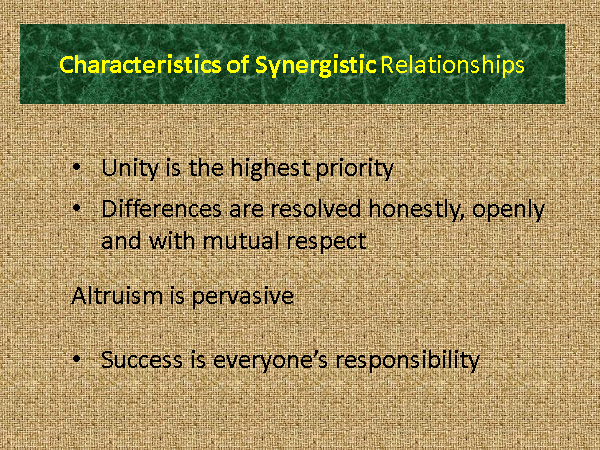
How should we define synergistic relationships?  Undoubtedly each social union takes on its own unique dynamics.  Nonetheless, there are certain characteristics that should be present in all of those that are truly synergistic.

1.       Unity is the highest priority:  No issue, personal interest, opinion or desire is more important than maintaining the solidarity of the relationship.
2.       Differences are resolved openly, honestly and with mutual respect:  Every living organism has feedback loops that continually adjust metabolic activities to restore and maintain homeostatic balance.  In a similar fashion, dialogue, compromise, cooperation and mutuality serve as the foundational principles that maintain the harmony within synergistic relationships.      
3.       Altruism is pervasive:  Everyone recognizes that they are part of a greater whole.  Therefore, the needs of others are regularly attended to with the same care one might exercised towards oneself.
4.       Success is everyone’s responsibility:  All members are equally committed to maintaining a harmonious internal relationship and insuring the effective achievement of the groups objectives and activities.
These are certainly not new precepts.  Religion, philosophy and the humanities have conveyed these admonitions throughout the ages.  What is new is the realization that these traditional sources were not merely offering esoteric niceties.  Instead, they have been expressing an intuitive awareness that evolution has designed us with a cosmic nature intended to fulfill the universal principle of synergy.


What is required is a fundamental shift in our attitude towards our social unions.  As a component within a matrix of collective entities, the question for each individual regarding every association is simply this, “How can I benefit this relationship?”  As that question begins to replace “How can I benefit from this relationship?” we will gradually witness a widespread transformation of our society.
Over the next few centuries, it is very likely that many of the current cultural differences that contribute to global conflict will fade as a result of international homogenization.  Certainly, technology and the related proliferation of information are leading the way towards that eventuality.  Equally significant will be the gradual decline in adherence to orthodox religious dogmas and a continued increase of interracial births.
If we are genuinely subject to cosmic progression, harmonious social cooperation will eventually become a significant collective aspiration.  The human record is full of examples of egalitarian cultures.  This is clear evidence that intuitively we know that our social relationships should be based on mutuality.  Ultimately, we will begin to actualize that which we are destined to manifest.