Friday, October 27, 2017

What About God? - Part I


“I won't say that I'm an agnostic, since agnosticism maintains that one cannot know... but I'm not averse to the idea of some intelligence or some organizing force that set up the initial conditions of the universe in such a way that ultimately generated stars, planets and life.” -- B. F. Skinner

“I am an agnostic; I do not pretend to know what many ignorant men are sure of.” -- Clarence Darrow


“The mystery of the beginning of all things is insoluble by us; and I for one must be content to remain an agnostic.” -- Charles Darwin

Fully exploring the existence and nature of God lies far beyond the scope of this blog.  It would, nevertheless, be inappropriate to consider reality without addressing the matter in some fashion.  What I offer here are merely my own thoughts about God.  Whether you agree, adamantly disagree or are completely indifferent,  I assure you that I have not arrived at my current views lightly.  They represent the conclusions derived from many years of literary research and extensive contemplation.

A minor difficulty in speaking about God is the lack of an appropriate gender-neutral pronoun.  Surely a being of this magnitude would have no need of gender.  In many polytheistic cultures we find a mixture of male and female gods.  However, within male dominated monotheistic societies He has traditionally been attributed with masculine characteristics and addressed as such.  Yet there are some ancient teachings that view Her as having both female and male attributes.
Addressing God as “It” seems rather impersonal and somewhat irreverent.  I recognize that there is no way to make everyone happy no matter what I choose to do.  So, I will alternate my pronouns as I refer to Her/Him.
Although specific doctrines may differ widely, the general concept of God in our western culture has been heavily influenced by the ancient polytheism of northern Africa, the middle east and Europe, as well as the three major Abrahamic religions, Judaism, Christianity and Islam.  It is a belief in a divine, anthropomorphic, transcendent being that is omnipotent, omniscient and omnipresent.  He has created everything, is intimately aware of the minutest details of our lives and is capable of intervening in the affairs of mankind.
Traditionally every phenomenon for which there is no known explanation has been attributed to God.  In the ancient world this included electrical storms, plagues, drought, infestations, earthquakes, eclipses and much more.  As scientific discoveries have identified the natural source of these events, the list of items requiring His direct involvement has diminished significantly.  Nevertheless, She is still blamed for causing horrible disasters that we refer to as “Acts of God.”  Simultaneously, in the midst of those tragedies, He is praised for protecting the survivor’s.  Apparently, God’s actions are capricious and completely arbitrary.
With this view of God, it is little wonder that people become angry with Her when hardship befalls them.  The universal cry is “Why?”  Implicit in that single word is a plethora of questions.  Why me?  Why my loved ones? What did we do to deserve this?  Why did You allow this to happen?
If we are to be completely honest, the ultimate question is simply this, “Why would an all-knowing, all-powerful, supremely wise and loving deity allow suffering?”  Even we, as mere mortals, respond to hardship with compassion and make every effort to alleviate it.  Why wouldn’t a superior being surpass our efforts to do so?  How is it possible to ignore the agonies experienced by innocents in war-torn regions or allow the physical and sexual abuse and exploitation of children?
Of course, many biblical passages deny the legitimacy of ANY questioning OF God’s actions.  The entire book of Job is devoted to addressing this very issue and concludes that, as creator, God is entitled to do whatever She chooses without reproach.  For Job this meant that crushing his children beneath a collapsed building, having many of his servants slaughtered by marauders, the theft and destruction of his possessions and afflicting Job with “painful sores from the soles of his feet to the crown of his head “were a justifiable test of Job’s faithfulness.
In Isaiah 55:8-9 we read “For my thoughts are not your thoughts,   neither are your ways my ways,” declares the Lord.   “As the heavens are higher than the earth,   so are my ways higher than your ways    and my thoughts than your thoughts.”  Are we to accept that this and similar passages are the only explanations we are to receive from a supernatural creator?  Are we supposed to passively affirm that all of the turmoil and destruction in the world are part of some divine master plan? Or, do these scriptures represent human efforts to mitigate the glaring discrepancies that exist between a particular theological conceptualization and events occurring in our observable reality? 
Embracing any faith-based religion requires more than belief in a higher power.  It is necessary to have confidence in the validity of the source of the theology being presented.  In the case of the Bible and the Koran, the credibility of the respective religions is completely dependent on an acceptance of these writings as direct communications from God and not merely of human origin.
Rejection of a particular religious perspective is not automatically a denial of the existence of divinity.  The majority of the world’ s population do not share the view of God set forth in the Abrahamic religions.  When Judaism was in its infancy in the middle east, Vedic yogis were pondering the universe and laying the perceptual foundations of Hinduism.  While the Greeks were expounding on the antics of the gods in their mythological pantheon, Buddhism, Confucianism and Taoism were spreading throughout the far east.  Those in this latter group were being established as major world religions centuries before Christianity and a full thousand years before Islam.
Though there are notable differences between the various forms of eastern religion, none of them envision an observant god who intervenes in the affairs of mankind and will eventually administer a final judgement. The primary focus is awakening to the unity that exists among everything in the universe.  The measure of one’s life is based on the degree to which we harmonize with other beings and the natural rhythm of the cosmos.  Reincarnation offers an endless cycle of lifetimes through which We progressively learn and grow until we achieve a state of enlightenment and are freeded from the need for rebirth.

So, who is right?  Inasmuch as the prevailing religious views were conceived in pre-scientific cultures, I think it is safe to say that none of them completely grasp the full magnitude of ultimate reality.  In our age of scientific discovery, some might question whether considering the existence of God is a relevant concern at all.  No matter what our present belief might be, the most significant question is whether or not we are open to a new perception of reality even if it challenges our current understanding.

Monday, June 12, 2017

Synergy is Weaving the Fabric of the Universe

Synergy is not a term that is in common use among the general public.  In many ways this is amazing because it is the underlying principle of our existence.  Synergy simply means working together and refers to the results of two or more elements joining together to produce an outcome that is greater than what would have resulted from the sum of their individual actions.  In general, the synergistic results are dependent upon the degree of harmony that exists between the elements.


This is evident throughout the cosmos.  Quarks join together to form protons and neutrons in the nuclei of atoms and serve as the building blocks of all matter.  Atoms unite to form organic molecules and life emerges.  Synergy is at work in the midst of algae colonies as they differentiate various functions.  Cells gather together and form complex organisms. 
This principle is not limited to non-sentient entities.  When humans function in a synergistic manner, they produce results that far exceed their individual potential.  The greatest barrier to us living at this level on a consistent basis is the complexity of our consciousness.  Because we are capable of recognizing our individuality, too often our personal interests prevent us from fully participating in relationships that are mutually beneficial.


There is a certain beauty manifested by the synergy of competitive rowing teams.  Countless hours are spent developing the harmonious rhythm of a unified stroke.  To the observer, these sleek vessels glide effortlessly through the water with a proficiency that is absolutely awe inspiring.  The challenges of transforming eight individuals into a single entity that thinks, breathes, and moves as one is masterfully conveyed in the book The Boys in The Boat written by Daniel James Brown.
When we take time to consider it, the role of synergy becomes evident all around us.  Symphonic orchestras, choral performances, ballet, and other art forms draw audiences into the harmony of the productions.  The unified focus of the individuals seems to blend into a single field of consciousness that can be experienced by everyone.
As we consider our cosmic origin and the role that synergy plays in our human experience, we are challenged to reflect on the implications for the full array of our social connections.  This new perspective is subtle yet extraordinarily profound.  When we view relationships holistically, it becomes evident that we are more than individuals merely associating with one another.  On the contrary, we are unique elements continually establishing, maintaining, and transforming higher forms of human consciousness.  Like eyes or ears, arms or legs, we each contribute to the quality and function of every relationship.
The only thing new about this perspective is being consciously aware of our social roles.  Intuitively we already experience this connectivity in deeply committed relationships.  Our physiological responses during our interactions and separations are actually measurable through a variety of scans and blood tests.
Altruism is the clearest evidence that at some level we already have an awareness of this human interconnection.  We are capable of performing amazing acts of compassion and generosity.  In the face of disaster complete strangers literally risk their own lives for one another.  Though personally unaffected, individuals frequently contribute finances, goods and services to victims of tragedies in distant locations. 
Why do we do this?  Wouldn’t it be better to simply let them die, preserve our own lives and keep the resources for ourselves?  No.  Deep within us we understand that we are all part of a greater Self and that helping others is critically necessary to our collective survival.
Scientist vigorously debate the origin, purpose and mechanism of this characteristic among humans and other species.  Unfortunately, it is difficult to understand altruism from a rigid adherence to a reductionist view of individuation.  Personally, I believe this ubiquitous phenomenon is quite simply a natural manifestation of an instinctive awareness of the holistic interconnection that exists among a wide range of lifeforms. 
We should not find this surprising.  As discussed previously, the universe is engaged in a process that continually attracts entities together to produce higher levels of complexity.  The fact that we are not physically joined together means nothing.  Atoms and molecules form strong functional bonds with vast physical distances between them. It is quite conceivable that living organisms are capable of establishing equivalent connections through the entanglement of consciousness?
When we use expressions such as “soul mates” and “our better half”, aren’t we acknowledging that we are part of a greater self?  When we suffer permanent loss through divorce, betrayal, or death, we speak of having our hearts ripped out or having a hole in our soul.  Is this anguish any less genuine than what we would suffer with the amputation of a physical limb?
Because we are not physically joined when we establish relationships, our tendency is to overlook the significance of the intellectual, emotional, psychological, and spiritual bonds that are formed.  However, the stability of those bonds can determine the health or dysfunction, the joy or pain, the life or death of every social union.  Furthermore, through modern technology these bonds have the distinct capability of being maintained over great distances and do not require that the various members be in immediate physical proximity.  Consequently, human synergistic potential is phenomenal.
As we become aware of this reality, this unified potential becomes limitless.  Individually, our greatest challenge is to discover our unique characteristics and direct them throughout our social network.  Collectively, through mindful collaboration, we have the power to transform and vitalize nearly every aspect of our social interaction.


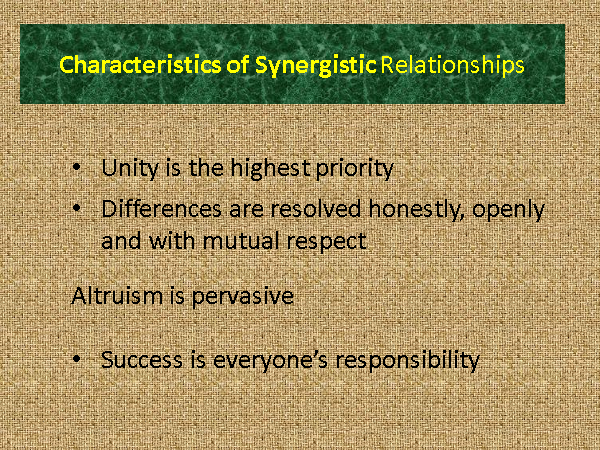
How should we define synergistic relationships?  Undoubtedly each social union takes on its own unique dynamics.  Nonetheless, there are certain characteristics that should be present in all of those that are truly synergistic.

1.       Unity is the highest priority:  No issue, personal interest, opinion or desire is more important than maintaining the solidarity of the relationship.
2.       Differences are resolved openly, honestly and with mutual respect:  Every living organism has feedback loops that continually adjust metabolic activities to restore and maintain homeostatic balance.  In a similar fashion, dialogue, compromise, cooperation and mutuality serve as the foundational principles that maintain the harmony within synergistic relationships.      
3.       Altruism is pervasive:  Everyone recognizes that they are part of a greater whole.  Therefore, the needs of others are regularly attended to with the same care one might exercised towards oneself.
4.       Success is everyone’s responsibility:  All members are equally committed to maintaining a harmonious internal relationship and insuring the effective achievement of the groups objectives and activities.
These are certainly not new precepts.  Religion, philosophy and the humanities have conveyed these admonitions throughout the ages.  What is new is the realization that these traditional sources were not merely offering esoteric niceties.  Instead, they have been expressing an intuitive awareness that evolution has designed us with a cosmic nature intended to fulfill the universal principle of synergy.


What is required is a fundamental shift in our attitude towards our social unions.  As a component within a matrix of collective entities, the question for each individual regarding every association is simply this, “How can I benefit this relationship?”  As that question begins to replace “How can I benefit from this relationship?” we will gradually witness a widespread transformation of our society.
Over the next few centuries, it is very likely that many of the current cultural differences that contribute to global conflict will fade as a result of international homogenization.  Certainly, technology and the related proliferation of information are leading the way towards that eventuality.  Equally significant will be the gradual decline in adherence to orthodox religious dogmas and a continued increase of interracial births.
If we are genuinely subject to cosmic progression, harmonious social cooperation will eventually become a significant collective aspiration.  The human record is full of examples of egalitarian cultures.  This is clear evidence that intuitively we know that our social relationships should be based on mutuality.  Ultimately, we will begin to actualize that which we are destined to manifest.


Thursday, June 1, 2017

Embracing Our Cosmic Nature

The unfathomable diversity evident in the material universe is due to the creative factors of attraction, organization and complexification.  As expressions of this universe, humans too have creative forces at work that are capable of directing us towards a level of social cohesion far above what is currently manifest among us.  They are displayed on the right side of the illustration below, attraction, social bonds and altruism.


Evolution has actually hardwired our attractive forces into the limbic region of our brain.  In his book, Spiritual Evolution, Dr. George E. Vaillant shares the results of decades of clinical research that demonstrate that the characteristics we associate with spirituality are of a genetic origin.  These include; love, joy, faith, hope, compassion, forgiveness, gratitude and a sense of awe.


If we take time to contemplate the implications of this reality, it becomes evident that the universe has designed us with a natural spiritual nature.  Vaillant points out that just as we differ from one another in stature, these spiritual characteristics also appear in individuals in varying degrees.  Nonetheless, taking time to cultivate these qualities can actually influence the development of certain regions of the brain and increase the prevalence of each of these positive emotions.  This is certainly the role religion, education and the humanities have played in human development over the millennia.


These characteristics lie at the heart of all constructive social relationships.  As we associate with one another, emotional and psychological bonds are formed that contribute to effective cultural development.  Of course, these bonds vary in degree from mere associations such as school and work to lifelong commitments of family and devoted friendships.
The ultimate expression of our social unions is seen in acts of altruism.  Caring for the concerns of others generally takes to forms.  There is an attitude of kindness that manifests in lifelong acts of service to others.  Whether it is a parent tending to the needs of their family, a nurse providing comfort to a patient, a teacher enabling his students to be lifelong learners, or someone holding a door open for an elderly couple, these all demonstrate a concern that reaches beyond our personal interests.
There is also an altruistic response that occurs in the midst of crisis.  Amazingly, it does not require any prior association but frequently takes place among complete strangers.  How often do we hear of people being pulled from burning buildings, mangled cars, or raging flood waters by those they have never met before?  What prompts individuals to leave a place of safety and risk their lives for others? 
I believe that all forms of altruism are attributable to an intuitive awareness that we are an integral part of a greater whole.  The natural spirituality that evolution has programmed into our genes is merely an extension of the ongoing complexification occurring in the universe.  Ideally, we are intended to unify in an interconnection that is mutually supportive.
 If this is true, why are we experiencing such extreme global turmoil?  Evolution is a slow process of trial and error as it blindly sorts through increasingly effectual configurations.  We must keep in mind that humanity is a very new species on our planet.  We are gradually stumbling towards a more unified global relationship and are currently engaged in a transitional period between outdated world views and a more rational understanding of who and what we are.
Arguably religion has been responsible for some of the most horrific human atrocities ever committed.  Nevertheless, the core message of every major religious teaching has expressed our natural spirituality, sought to establish social norms, encourage personal character development and provide a sense of community.  As yet, no comparable social institution has emerged to articulate contemporary universal knowledge, values and solidarity.  Consequently, we are witnessing widespread individualism, materialism, and militant religious factions vying for world domination.
Thankfully, in the midst of this stormy global climate, we see tremendous acts of kindness and courage.  The internet is full of websites promoting peace, positive values, respect and mutual support.  Many within the humanities are generating creative artistic images ideally suited for a collaborative and nurturing future.    Clearly our collective cosmic nature is alive and well working diligently to bring about necessary changes for a favorable human destiny. 

Our individual challenge is to find ways to contribute to this effort.  It is essential that we cultivate our natural spirituality through meditation, contemplation, communing with nature, seeking inspirational reading material, movies and music, or whatever may be personally uplifting. Then, actively seek opportunities to engage in random acts of kindness. Always remember, even the smallest candle can dispel the darkness that surrounds it.

Wednesday, May 17, 2017

Has the World Gone Crazy?

As we scan both national and global events, we may find ourselves overwhelmed by the apparent insanity that is unfolding all around us.  The tragedy of this situation is compounded by the fact that scientific research indicates that human consciousness appears to be the most extraordinarily complex and sophisticated entity the universe has produced thus far.  Do the current conflicts indicate that we have reached the height of our development and are engineering our species’ extinction?  Or, is it possible that we are witnessing a tumultuous transition from conflicting world views that were conceived in pre-scientific cultures towards a more contemporary understanding of our humanity?
In the previous post, Our Creative Universe, I presented six cosmic factors that serve as categories for every occurrence in the universe, repulsion, attraction, chaos, organization, entropy and complexification.  Inasmuch as we are expressions of the universe, our social interactions can be similarly grouped into six social factors that can be easily identified and understood, alienation, attraction, conflict, social bonds, egocentrism and altruism.


This model provides an effective way to recognize the nature of our own behavior as well as that of others.  Although life’s events may appear perplexing at times, learning to recognize what is going on can aide in developing more objective and rational strategies.  In reality, it’s not as complicated as it may seem.
The last few posts have been rather lengthy, so I am only going to address the items on the left side of the illustration at this point.  They are the destructive factors that prevent and destroy cohesive and harmonious social relationships. I will present the creative factors in subsequent posts.


Without doubt, egocentrism is a greater barrier to our cultural evolution than any other factor.  Its manifestations run the gamut from the temper tantrum of a toddler to the severe brutality of a dictator.  It lies at the heart of every conflict and generates and sustains the full range of alienation.  When people assert that “nothing ever changes”, that sentiment is generally directed towards the destructive behaviors associated with extreme forms of selfishness.


For a young child who lacks the knowledge and ability to provide its own necessities, it is developmentally appropriate to be self-centered.  We expect wild animals to engage in acts of self-preservation.  Yet when we observe similar attitudes and actions in adults, we recognize that it represents a serious character flaw.  The list of divisive attributes of egocentrism are limitless.


Unfortunately, it is easier to recognize egocentricity in others than it is in ourselves.  From our perspective, we are not self-centered, we are merely independent.  Certainly, individuality is highly valued in our culture, but from a holistic view, is that really a virtue?
Should we admire the rich and powerful?  Are those praiseworthy who amass their fortunes through the labors of the middle and lower class by withholding employment benefits and adequate compensation? Should we compliment the giants of corporate America who control energy, healthcare and other essential goods and services, forcing families into voluntary slavery while the executives indulge in unbounded opulence?
No, I would suggest that those who engage in brute capitalism foster the poverty they distain and are actively engaged in crimes against society.  We need to recognize extreme wealth for what it is, pure selfishness.    The frustration and anger of the working class and poor are understandable and probably justified.  We can only hope that an equitable redistribution of resources can eventually occur in a peaceful manner.
The religious conflicts and actions of despotic world leaders are no different.  They are further evidence of egocentrism.  Sadly, as long as people are willing to embrace the exaltation of individuals, candidates will vie for their place on the pedestal.
Albert Einstein offered us the key to a brighter future when he said, “No problem can be solved with the same level of consciousness that created it.”  Indeed, if the insanity is to end, we will need to view our existence from a completely new perspective.


Sunday, May 7, 2017

Our Creative Universe

From the instant of the initial burst of energy that propelled our universe into existence, it has been engaged in a path of progressive complexification that has led to unbounded creative expressions.  There are several complimentary and opposing factors that have been instrumental in its development.  As presented in the illustration below, they are repulsion, attraction, chaos, organization, complexification, and entropy.  They manifest in innumerable ways, are ubiquitous and their influence is universal.


The items on the left are generally destructive and contribute to the perception of the cosmos as a rather hostile environment.  Yet, the items on the right are continually at work within those conditions in amazingly creative ways.  Physicists have identified four “attractive forces” that account for the structure of matter; strong and weak forces which maintain the integrity of the nuclei of atoms; electromagnetism which enables atoms to form bonds and maintain molecules; and, gravity, the weakest of these forces, is able to extend over enormous distances and compress gigantic hydrogen  clouds into stars fueled by nuclear fusion, hold billions of stars in a rotating galaxy and draw multiple galaxies into swirling galactic clusters.
As matter is drawn together by these attractive forces, it tends to organize into infinite combinations, patterns and increasingly complex entities.  This is evident in both living and non-living phenomena everywhere on our planet.  Furthermore, the proliferation of stars throughout the cosmos suggests this creative force is at work on a universal scale. 
Our presence in the universe is entirely due to the fact that we are living in a spiral galaxy that has density waves that circulate around our spinning stellar neighborhood.  As they pass through clouds of matter that have been expelled during supernovas, elements are brought into closer contact where the force of attraction can exercise a greater influence.
These gigantic clouds begin circulating in ever tightening spirals.  Eventually a star is born in the center of this swirling stardust.  The matter orbiting around the star comes into contact, begins bonding, and new cosmic structures are formed.  They may be nothing more than a few pebbles at first, but over time they become rocks, asteroids, comets and finally, planets.
These were the events that led to our existence.  Our natural perception of our world is one of a stable planet.  It is difficult to imagine a time when it did not exist.  However, the reality is that about five billion years ago, the atoms that comprise everything around us, our homes, the ground beneath our feet, our loved ones, even our own bodies, were simply floating in space as part of an enormous cloud that had been expelled from a star, or perhaps several stars.  Yes, we and everything we perceive around us are quite literally made of stardust.
The early stages of our solar system were extremely chaotic and violent.  The gravitational force of our planet compressed the core and heated it into a molten mass.  Our thin outer crust was initially quite vulnerable to eruptions from within.  In fact, approximately 250 million years ago a lava flow lasted for a million years in the area that is now Russia. 
The tumult was not limited to events occurring on the planet alone.  Asteroids, meteors, and comets frequently impacted the surface.  At one point the Earth collided with a smaller developing planet that penetrated deep into its core and caused a large portion of the Earth to break off and be propelled into space.  Fortunately, the Earth’s gravitational force caused that mass to settle into an orbit around it, where eventually it was shaped into a sphere of solid rock which we now know as the Moon.
The tendency is to view all of these events as violent episodes of random chaos.  Many consider our universe a hostile environment, but I would argue that that perception is based merely on our geocentric point of view.  Certainly life, as we know it, could not have survived the colossal upheavals presented thus far.  However, if we can maintain a cosmic perspective, the progressive advances of the universe become evident.
Do we see the hand of God in this or is it actually a natural process that expands and attracts, produces order in the midst of chaos, and transforms simple matter into complex structures? Based on Newtonian physics, it is hard to imagine inert atomic particles producing such an amazing cosmos without some deity guiding the events.  However, it now appears that Newton’s understanding of a strictly mechanical universe may have been incomplete.
When science discovered the realm of quantum physics, it became clear that atoms are not as inert as originally thought.  In fact, in 1977 Ilya Prigogine was awarded the Nobel Prize in chemistry for his work demonstrating the self-organizing properties of matter.  This organizational tendency would certainly explain the gradual progression towards structured complexity that has been unfolding since the initial moment of the Big Bang.
Nowhere is this more evident than what transpired during the formative years of our planet.  In the midst of the primitive environmental instability certain molecules established a mutually supportive relationship that led to a quantum leap in complexity.  Without question, this is the greatest mystery of all.  How did life emerge from this molecular accumulation?  Even in its simplest form, organisms consist of billions of atoms bonded in harmonious relationships that form differentiated substances performing diverse tasks in a fully integrated system.
The cells were extremely simple at first, but the fact that there were cells at all is nothing short of miraculous.  How did molecules establish cell membranes to contain and protect the internal contents?  What prompted ingestion, respiration, excretion, photosynthesis, or reproduction?  Whatever generated this amazing phenomenon, one thing is certain: all living organisms alive today are direct descendants of this first life form.  Although you will never find the documentation on Ancestry.com, the life force that animates you, me, and every other human on the planet has come from a single source that emerged over three billion years ago.
When we consider the progression of complexity on the earth beyond the emergence of life itself, two major events stand out.  First, the transition from single-celled organisms to multi-celled organisms propelled life onto a path of unbounded diversity which is still underway.  For the first 2.7 billion years (a timeframe that exceeds our comprehension) the earth was populated with single-celled organisms.  Considering the volatility of the environment during that period, these were well suited for survival.  Even today these forms of life thrive in a wide range of environmental conditions and can be found in the permafrost of Alaska as well as hydrothermal vents at the bottom of the ocean where temperatures can exceed 500 degrees.
About eight hundred million years ago certain life forms failed to complete the separation during cell division and were apparently benefitted by the union.  Before long, multi-cellular organisms proliferated the environment.  Amazingly this occurred both in the animal kingdom as well as among plants, resulting in extensive divergence of species and innumerable varieties.  Somewhere in the midst of that early collection of microscopic organisms were a few who would eventually evolve into primates, then homoerecttus, homosapians, and finally modern man.  Others would become horses, lions, peaches and spinach.  Without this critical progression, we would still be floating around in some algae bloom with a life expectancy of a few days at best.  As it is, the law of complexity never appears to be content with the latest emergence.  Instead, complex elements are continually drawn together to form new expressions of creativity.
The second incredible occurrence was the appearance of human consciousness.  If this had failed to transpire, we would still be wandering around some African savanna scavenging for fruit and small animals while we tried to avoid becoming dinner for those who were higher on the food chain.  Many scientists debate what factors contributed to the growth of our brains.  But more significant than the reason is the fact that approximately five million years ago Neurons simply began proliferating and integrating in our   neocortex and produced a brain capable of reasoning in ways far superior to the rest of the animal kingdom.
That transformation almost guaranteed our survival and delivered us from an existence in which progress is totally dependent upon physical adaptation.  We have become a life form that is capable of examining the source of its origin, comprehending the laws that govern matter, contemplating the meaning of life, imagining, creating, and influencing the future of our planet.  In our sphere of awareness, human consciousness has become the most complex entity the cosmos has created thus far. 
Of course, we do not merely observe the universe: we are the universe discovering itself.  This realization is held by many scientists including Bill Nye the Science Guy.  Furthermore, the creativity evident throughout the cosmos is also expressed through human consciousness.  Every work of art, every musical composition, all of the books ever written, each new technical development and every poem ever recited are refined manifestations of that universal creativity.

If and when we focus that creativity on our social development, we will be able to transform our planet into the harmonious global community that has thus far existed primarily in our imaginings.  We must simply keep in mind that every, human accomplishment begins as a thought.  Those thoughts then become things.  There is absolutely no reason to doubt our ability to create a brighter future for mankind.  So, dare to dream.

Friday, April 28, 2017

A New Cosmic Story

As presented in a previous blog, The Foundations of Reality, our cosmic story plays a foundational role in the way we perceive and interact with everything that exists in our material world.  At present, those cultural and individual stories are amazingly diverse; however, as long as we are able to respect one another’s right to hold an alternative view, this cornucopia of beliefs poses no hindrance to peaceful coexistence.  Unfortunately, too often we observe the hostility that can result when beliefs are sustained through inflexibility and intolerance.
What shifts in our thinking would need to take place to nurture a more harmonious global culture?  Is there a story that could be embraced by the majority of the citizens of our planet?  If so, the task of promoting an inclusive international identity could become achievable. 
Traditional cosmic stories have had thousands of years to develop and convey their doctrines, mythologies, and icons.  These competing tales were born from speculation, contemplation, personal revelation, or visions and have lacked cross-cultural acceptance.  However, a new scientific understanding is emerging that is based on verifiable observations.  As this new empirical knowledge permeates various societies, it has the potential to influence these traditional stories and bring us to a common understanding of our human destiny.
In light of the numerous conflicts currently underway around the world, this may sound like mere wishful thinking.  However, we need to keep in mind that this new cosmological view is incredibly young and has not had adequate time to exercise significant influence on our global community.  Many of our most profound discoveries have either taken place or been confirmed within the last twenty-five years. The launch of the Hubble telescope opened the window on the universe, and what we are beginning to see is extraordinary.
Of course, what is being revealed is not really a new story at all.  It has been going on since the initial expansion began approximately  14 billion years ago.  What is new is our understanding of the cosmology involved in the production of our universe and the subatomic structure of matter.  Our natural senses are limited and do not accurately reflect the reality of the physical realm.  Consequently, most of our previous beliefs, attitudes, and behaviors have primarily been based upon primitive perceptions that are incredibly incomplete.
Traditionally, our observations and conclusions have been founded on a centrist point of reference; egocentric, kin-centered, clan-centered, ethnocentric, nationalistic, anthropocentric, and geocentric.  This perspective is reflected in our daily lives.  We still refer to the appearance and disappearance of the sun as sunrise and sunset, as though the earth is standing still while the sun courses across the sky.  I’m not suggesting any campaign to alter our language, but the event would be more accurately referred to as the morning and evening rotation.
Consider the term “outer space.”  What does that mean?  Again, it is a geocentric expression that implies that space is something that exists out there somewhere, as though we are not part of it.  Although our presence is rather insignificant, we are in fact an integral part of the universe.  During the lunar landings in the late 60s and early 70s, the truth of that reality became quite evident as we began seeing photographs of our planet silhouetted against the blackness of space.

 
We Are Expressions of the Universe

Both individually and collectively we are expressions of the universe.  It is easy for us to view galaxies, stars, planets and moons as such, but we do not typically think of ourselves in these terms.  Perhaps it is time to do so.  In the documentary Journey of the Universe, Brian Swimme presents the profound observation cited below. It succinctly highlights the reality that we are each an aspect of this universal process.

“Over the course of fourteen billion years, hydrogen gas
transformed itself into mountains, butterflies, the music of Bach, and you and me.”
--Brian Thomas Swimme

This is a relatively new understanding based on rational thought and empirical observations.  However, intuitively we have known this for thousands of years as evidenced by the numerous religious traditions and scriptures alluding to our connection with the heavens.  Until now, our intellect had to be transcended because our natural observations were incapable of affirming this reality. 
In western culture our sense of cosmic connection has been sustained by denying our natural reason and expressing faith in an omnipresent, omniscient, omnipotent, invisible, and transcendent deity that created heaven and earth.  In all of the Abrahamic religions, we find sacred texts that affirm that God dwells in the heavens along with his angels.  Furthermore, Christians, Muslims, and some Jews anticipate an afterlife in some spiritual heavenly realm.
Eastern philosophy simply declared that our dualistic perceptions are illusions.  Through deep meditation, devotees were able to achieve “enlightenment” and experience a revelatory awareness that “all is one.”  Originating in the Vedic teachings of the Hindu faith around 1,500 BCE, it extended through Buddhism, Taoism, and many of the eastern philosophies.
During the fourth century BCE, atomism emerged as an explanation of the natural world simultaneously in Greece and India.  It was the belief that all matter is comprised of tiny particles that vary in size and shape and form bonds in infinite combinations.   The Greek philosophers, Leucippus and Democritus, coined the term atom, which simply referred to tiny particles that were irreducible.
Atomism played a key role in Epicurean philosophy.  Around 50 BCE, an Epicurean named Lucretius wrote On the Nature of Things, an epic scientific discourse in the form of a poem that presented amazing insights pertaining to the role of atoms in the cosmos.  Some of the assertions are as follows:

-          There is nothing in the universe other than atoms and void.
-          All material objects are comprised of atoms including the heavenly bodies.
-          Stars are neither gods nor mystical.  They are suns just like ours, composed of atoms and orbited by satellites that are inhabited by living creatures in the same way our planet is.  They appear tiny because we are merely observing them from a great distance. 

What is amazing is the fact that all of this intuitive knowledge came through nothing more than natural observation, meditation, contemplation, and logic.  They had no telescope or knowledge of the actual events that formed the material universe.  They were not aware of nuclear physics or the fundamental aspects of quantum mechanics.  Yet they sensed a cosmic unity that is completely compatible with our current understanding of field singularity and the emerging concepts of string theory. 
The source of these incredible insights is expressed in the Tao Te Ching, “How do I know this?  I look inside myself.”  As this ancient wisdom is affirmed through the scientific method, our rational and intuitive minds are free to integrate and establish a state of harmonious understanding as we collectively write our new unfolding cosmic story.

Reflections:
As you mindfully contemplate this unfolding cosmic story, what implications arise regarding the following issues?

-          Your sense of meaning and purpose as a unique element within an evolving universe;
-          Your perception of the moon, stars, and other galaxies as traveling companions; and
-          Your theology.


Friday, April 21, 2017

Honoring the Old Stories

I have developed a deep respect for our ancient forbearers.  Often when I thought of homosapiens who lived 200,000 years ago, the tendency was to think of them as separate from myself.  However, we are directly descendant from them.  We may not be able to use Ancestry.com to trace the lineage all the way back, but our DNA is nearly identical. 
It is impossible for us to comprehend the intellectual challenges that faced them.  As language was just emerging, they were trying to make sense of a world void of knowledge and information.  In many ways, it was like trying to put a 50,000-piece jigsaw puzzle together with no idea what it was supposed to look like.
In our age, we are so proud of ourselves because large sections of the puzzle are finally starting to be assembled.  The more we understand, the faster we can locate the missing pieces; however, they had just been given everything in a brown paper bag with no picture and didn’t even know what they were supposed to do with it. 
Perhaps we should treat their errors gently and at least give them credit for the groundwork they laid for us.  With no concept of the age of the universe or an awareness of the creative nature of evolution, it is completely understandable that they would have attributed the material world to the handiwork of a superior being.  The form and function of living organisms, the rhythm of the tides and seasons, the predictable paths of the heavenly bodies all seemed to reflect the design of an omniscient intellect.
Initially, everything that was unknown or mysterious was attributed to God.  Progressively we have discovered the natural explanations for storms, plagues, eclipses, and countless other phenomena that perplexed our ancestors.  In doing so, we have diminished both the relevance of divinity and the validity of ancient scriptures.
For several years, I simply disregarded ancient writings.   To me they were based on superstition and ignorance.  More recently, however, I have recognized that error and truth can coexist within the same source.  Newton and Kepler are prime examples.  Both were outstanding mathematicians, advanced our knowledge of motion and optics, and used the Bible to meticulously calculate the date of creation.  Certainly no one would suggest that we dismiss their contributions to science simply because they still viewed the Bible as a valid historical resource.
When we overlook the myths, and embrace the metaphors and archetypes in those old texts, we discover an incredible wealth of wisdom regarding human interaction and harmony.  For several hundred thousand years, our forefathers lived in hunter-gatherer bands.  There, they recognized their interdependence and need for cooperation.  Much of what was learned in these egalitarian societies has been preserved through oral and then written tradition.
This awareness offers a new appreciation for many of the admonitions contained in sacred texts.  As children, we are subject to the household rules and values set forth and enforced by our parents.  When we reach adulthood, we establish our own homes free from that authority.  Nevertheless, we typically continue to observe many of the precepts from our childhood, not due to fear of punishment, but because we recognize the validity of the guiding principles.
In a similar fashion, a large segment of our modern age has declared its independence from the dictates of religion.  Unfortunately, there is currently no alternative widely accepted contemporary social institution that is focused primarily on personal character development and cultural solidarity.  Consequently, we are like children who have lost their parents.  Some are mature enough to appreciate the traditional values.  However, others seem to exhibit an adolescent preoccupation with their own interests and generally disregard the welfare of the rest of the family.
It is little wonder that the world seems to overflow with conflict and severe inequities.  In light of this reality, can we afford to overlook the wisdom of people who understood how to live together in peace?  Perhaps it is time for some social maturity that allows us to openly embrace the values presented in scriptures without a need to affirm deity or fear the reproach of sceptics.
When we lay aside the issue of the divinity of Jesus, we recognize that he is the personification of our human aspirations.  He is the fulfillment of who we want to be; who we ought to be; who we can become when we place our faith in the possibility of our ultimate potential.  Over the years, many have suggested that the world would be a better place if people simply lived more like Jesus.  When we consider him or other spiritual leaders as role models, it becomes apparent that their formulas for personal salvation are secondary to the redemptive potential these spiritual paths could have for all of humanity.
Is there better advice than what Jesus is credited with saying in the Sermon on the Mount?  “Blessed are the peacemakers … love your enemies … pray for them who spitefully use you … turn the other cheek … go the second mile….”  The message of sacrificing oneself for others is captured in the Gospel of John where Jesus is quoted as saying, “No greater love has any man than this, than he lay down his life for his friends.” 
Is there a better description of love than what is attributed to the apostle Paul in the 13th chapter of first Corinthians?

If I speak with the tongues of men and of angels, but do not have love, I have become a noisy gong or a clanging cymbal. If I have {the gift of} prophecy, and know all mysteries and all knowledge; and if I have all faith, so as to remove mountains, but do not have love, I am nothing.  And if I give all my possessions to feed {the poor,} and if I surrender my body to be burned, but do not have love, it profits me nothing.  Love is patient, love is kind {and} is not jealous; love does not brag {and} is not arrogant, does not act unbecomingly; it does not seek its own, is not provoked, does not take into account a wrong {suffered,} does not rejoice in unrighteousness, but rejoices with the truth; bears all things, believes all things, hopes all things, endures all things.  Love never fails...." (I Corinthians 13:1-8 N.A.S.B.)

Over several centuries following Buddha’s death, the oral traditions preserving his teachings were compiled into a book known as the Dhammapada.  Like the Bible, several versions currently exist.  Nevertheless, they contain similar affirmations that convey the core message of Buddhism; the importance of attaining enlightenment, right thinking, right living, loving kindness towards all creatures, and a commitment to communal harmony.
The Dhammapada is not a narrative intended to be read extensively at a single sitting.  Instead, more than 400 verses convey simple, easily understood precepts for contemplation and meditation.  Many of the affirmations present deep truths using colorful imagery.
Consider the following:

1.      All that we are is the result of what we have thought.  It is founded on our thoughts. It is made up of our thoughts.  If a man speaks or acts with an evil thought, pain follows him, as the wheel follows the foot of the ox that draws the carriage.
2.      All that we are is the result of what we have thought.  It is founded on our thoughts. It is made up of our thoughts.  If a man speaks or acts with a pure thought, happiness follows him like a shadow that never leaves him.
13. As rain breaks through an ill-thatched house, passion will break through an unreflecting mind.
14. As rain does not break through a well-thatched house, passion will not break through a well-reflecting mind.
145. Irrigators regulate the waters, fletchers straighten arrow shafts, carpenters shape wood, and the good control themselves.
162. Just as a single creeper strangles the tree on which it grows, even so, a man who is exceedingly depraved harms himself as only an enemy might wish.
While Buddhism was spreading throughout India, Confucianism and Taoism were emerging in China.  I have found philosophical Taoism to be compatible with my personal cosmic views.  Lao Tzu, the father of Taoism, is credited with authoring the Tao Te Ching, a revered text among Taoists.  It is rather short and concise, yet incredibly profound.  Its brevity may be due in part to one of its observations, “Those who know don’t speak.  Those who speak don’t know.”
In a world that is currently embroiled in armed conflict in numerous locations and a nation that experiences more than 30,000 firearm homicides annually, is there a more pertinent view than what was offered by Lau Tzu 2,500 years ago?

31
Weapons are the tools of violence;
all decent men detest them.

Weapons are the tools of fear;
a decent man will avoid them
except in the direst necessity
and, if compelled, will use them
only with the utmost restraint.
Peace is his highest value.
If the peace has been shattered,
how can he be content?
His enemies are not demons,
but human beings like himself.
He doesn't wish them personal harm.
Nor does he rejoice in victory.
How could he rejoice in victory
and delight in the slaughter of men?

He enters a battle gravely,
with sorrow and with great compassion,
as if he were attending a funeral.

There is no direct English translation of the word “Tao.”  Generally, it means “the way,” but a more accurate understanding might be the natural way things occur in the universe.  Consider this definition and the impact it would have on our national politics if applied to the following passage from the Tao Te Ching:

61
When a country obtains great power,
it becomes like the sea:
all streams run downward into it.
The more powerful it grows,
the greater the need for humility.
Humility means trusting the Tao,
thus never needing to be defensive.

A great nation is like a great man:
When he makes a mistake, he realizes it.
Having realized it, he admits it.
Having admitted it, he corrects it.
He considers those who point out his faults
as his most benevolent teachers.
He thinks of his enemy
as the shadow that he himself casts.

If a nation is centered in the Tao,
if it nourishes its own people
and doesn't meddle in the affairs of others,
it will be a light to all nations in the world.

(Translations by Stephen Mitchell)

Most diamonds are mined from deep within the earth.  To the untrained eye, they appear to be nothing more than common rocks.  However, when they have been cut and polished, their true value becomes apparent.  In a similar fashion, reflecting on texts from antiquity may require sorting through outdated concepts of the origin of the cosmos, descriptions of the afterlife, and doctrines regarding the proper way to access the “right” path, but in the midst of this surrounding material lie precious gems of universal wisdom.
When we mindfully consider the spiritual and philosophical writings of previous generations, their music and art, it becomes evident that these are expressions from minds and hearts that spent countless hours in silent contemplation prayer, and meditation.  Undistracted by the din of modern electronic media, they were able to explore the depths of their inner being and bring forth treasures that are still capable of inspiring us today.